
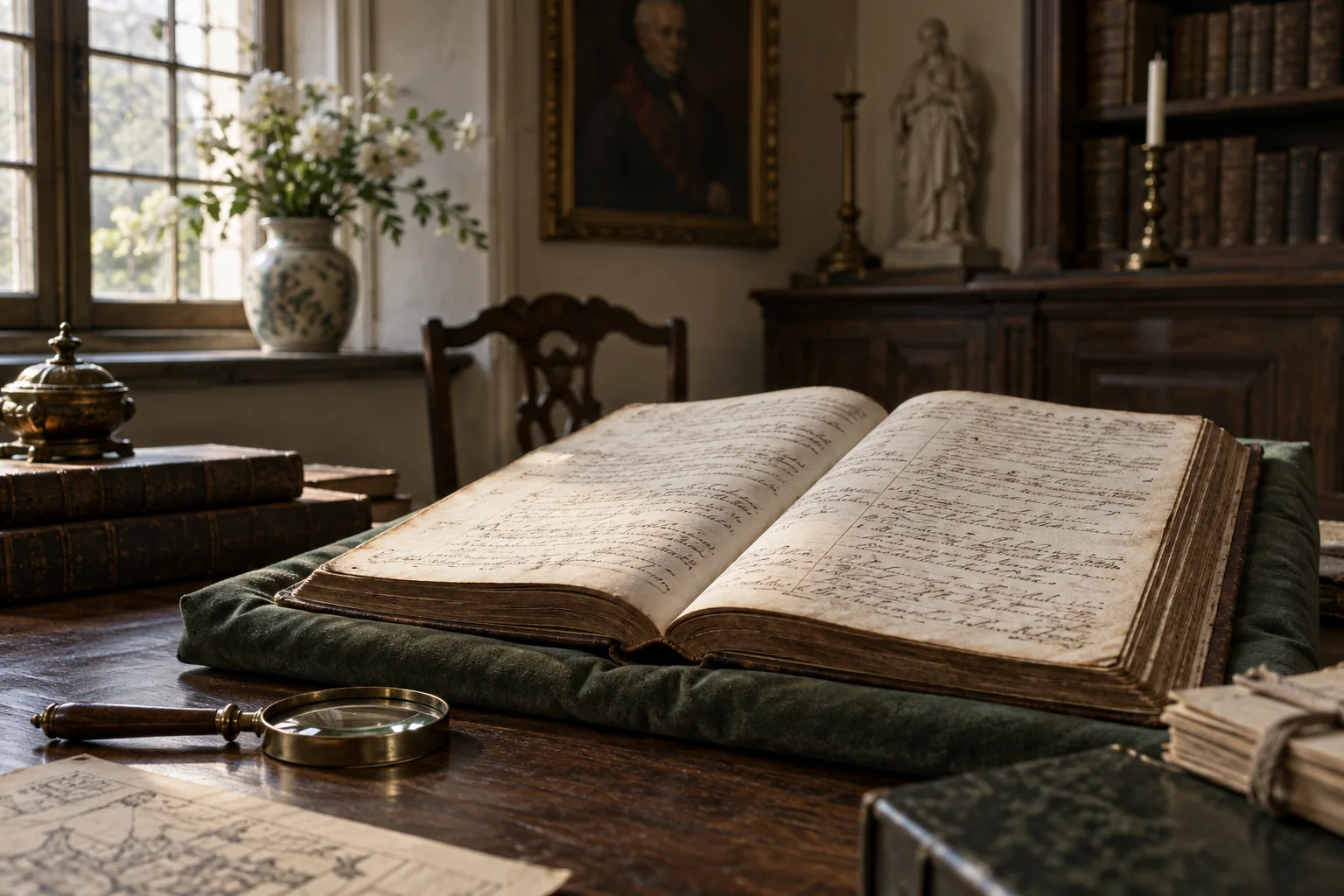
The family folder contains only grandmother’s marriage certificate. There is no tree, labelled album or precise knowledge of her parents. That is already a useful start. One properly documented record can begin a search that others can retrace step by step.
The examples are illustrative. Sources checked on 16 September 2026. This article concerns Polish law and records.
Start with someone you can document
Write down names used at different times, dates, places and family relationships, with a source for each fact. Separate the document’s contents from a relative’s memory and your own hypothesis.
‘How can I establish this person’s parents?’ is more precise than looking for everyone with the surname. It helps check whether each new document genuinely develops the same history.
Read beyond the name and date
Historical records may identify parents, spouses, age, occupation, residence and witnesses. Coverage depends on the record type, period and place. A marriage entry may also point to supporting attachments.
The State Archives note that historical entries can be incomplete or difficult to read. Examine the entire scan, adjacent pages and the volume’s identification. A marginal annotation may change how the main text is understood.
Registry office, archive or parish?
Records about one family are not necessarily held together. Polish civil-status legislation sets storage periods of 100 years for births and 80 for marriages and deaths, calculated under statutory rules, with provisions for archive transfer. Expiry does not mean a scan is already online.
Access rights also matter for more recent records. Eligible persons include the person concerned, spouse, ancestors, descendants and siblings, as well as those demonstrating a legal interest. Curiosity about a surname is not always sufficient.
Basis: [2] art. 28 and 45
Make each discovery reproducible
Record what the document confirms, what remains uncertain and what record should come next. Save a full copy and retrievable details: institution, collection, reference, year, entry number and page where available.
Do not guess an illegible surname into correctness. Mark uncertainty in the transcription and compare other documents later. A note recording doubt is more valuable than an unsupported branch of a beautiful tree. For official use, separately check whether a certified copy is required.
What to prepare
- A full copy including margins and volume identification.
- Confirmed facts and uncertain readings listed separately.
- Precise source description and repository.
- One concrete question for the next research step.
Remember
The most useful first record links a known person to the next verifiable fact.
Sources and references
Official legislation, judgments and institutional materials. The relevant sources are identified below each section.
- Polish State Archives — genealogy: sources and repositories — opens a new windowRelevant guidance and reasoning
- Polish Civil Status Records Act — consolidated text, 2026, item 393 — opens a new windowart. 28 and 45
- Gov.pl — obtaining a birth, marriage or death certificate — opens a new windowRelevant guidance and reasoning