
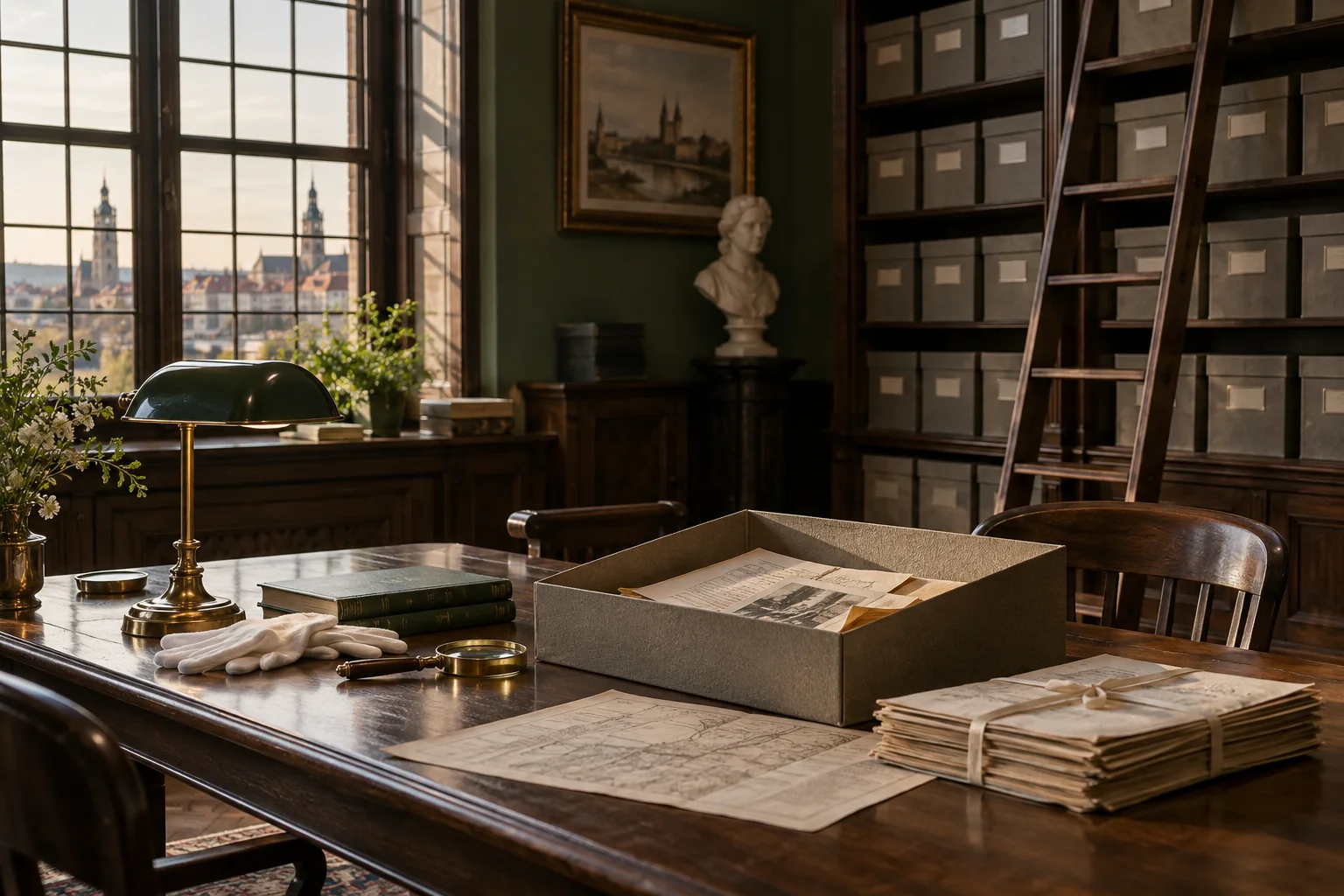
An online search does not find great-grandmother’s birth record. The family concludes that it burned during the war. Yet only one database and surname were searched. Before declaring a record lost, identify what was searched and how the collections are described.
The examples are illustrative. Sources checked on 16 September 2026. This article concerns Polish law and records.
A surname search does not examine every volume
A search engine may cover collection descriptions, archival units, scans or selected indexes. An absent name in results does not mean it is absent from the register. Search by locality, institution, record type and year too.
Record the database, surname variants, year range and filters used. This avoids repeating the same work a month later and explains exactly what a negative result means.
A catalogue description is already a discovery
If a volume covers the relevant period, note the archive, collection, unit title, dates and reference. These support a specific enquiry about access or copies. You need not recount the entire family history when the record sought is identified.
Check the holding institution’s notices too. The State Archive in Kalisz has described a separate service containing scans not yet available on the central portal. Absence from one site is therefore not the end of the search.
Ask a question that can be answered
Specify the person, event, place and the narrowest feasible date range. Add the reference if known and the source leading to the collection. Ask about the particular unit and, where relevant, research or reproduction conditions.
‘Do you hold this volume?’ differs from asking someone to reconstruct an entire family. Keep the archive’s reply: even confirmation of missing years helps plan further work.
If the record really has not survived
Describe the confirmed gap and consider other sources for the event or person: a later marriage record, another relative’s record or a lead to supporting papers. Each lead needs independent verification.
Do not replace a missing record with an unsourced online tree. Report what is established, what is absent and what remains unresolved. A properly documented negative search narrows the field and prevents unjustified certainty.
What to prepare
- Databases and filters actually searched.
- Historical locality, denomination or office, and years.
- Archival unit reference and repository, where known.
- Institutional replies and a plan for alternative sources.
Remember
Identify whether the missing element is the index, the scan or the document itself. That determines the next step.
Sources and references
Official legislation, judgments and institutional materials. The relevant sources are identified below each section.
- AGAD — practical guide to genealogical research — opens a new windowRelevant guidance and reasoning
- State Archive in Kalisz — additional digitised records service — opens a new windowRelevant guidance and reasoning