
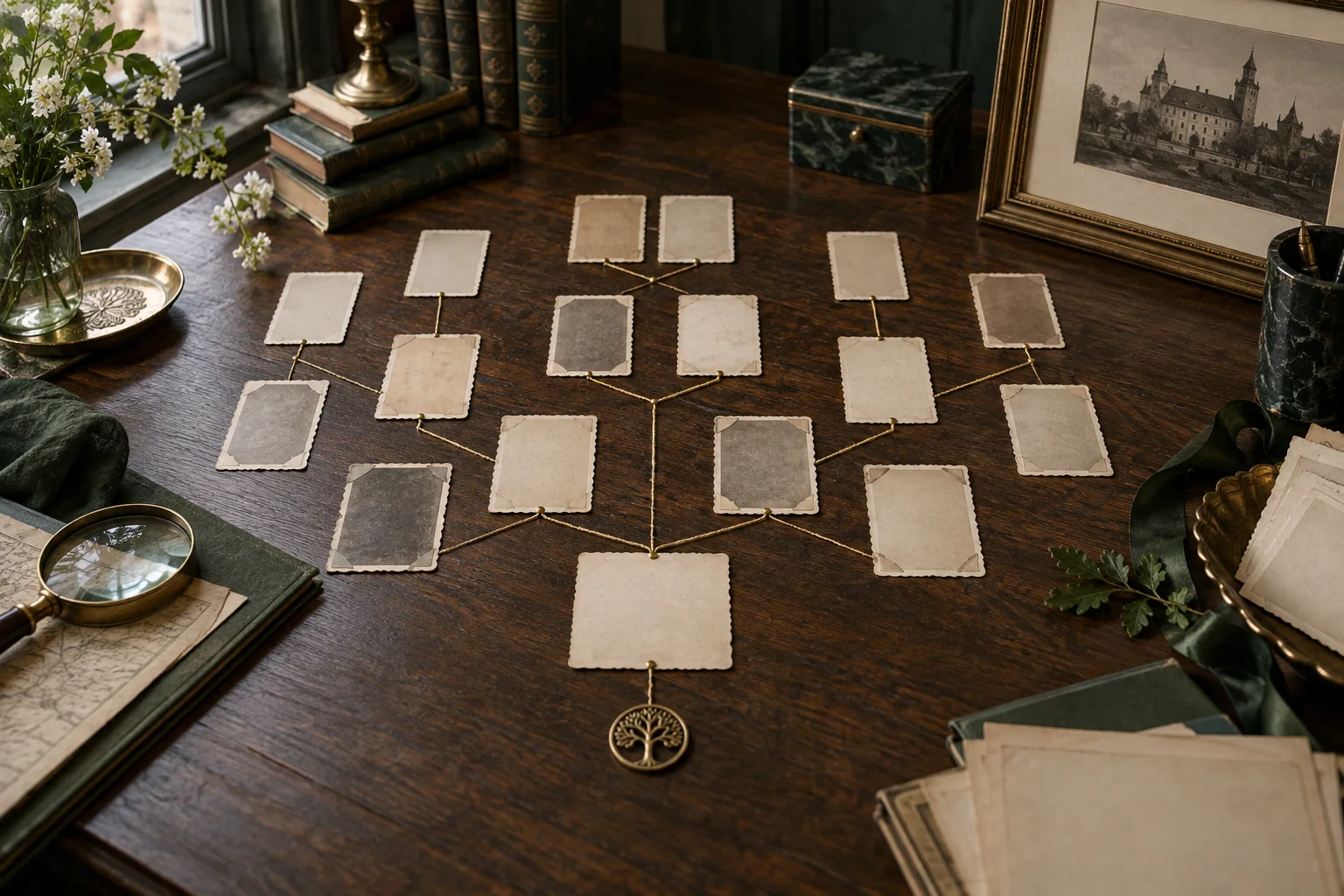
A cousin sends a large online family tree suggesting that a dozen people descend from a former house owner. Some branches lack sources and a death date is approximate. Is this enough to identify current heirs? It starts the conversation but is not a finished finding.
The examples are illustrative. Sources checked on 16 September 2026. This article concerns Polish law and records.
Every connecting line needs evidence
For each parent-child relationship, record the supporting document. For a changed surname, identify evidence linking the earlier and later identity. Research then checks specific links rather than merely collecting names.
An evidence register can list person, assertion, source, exact location and confidence level. ‘Anna’s mother was Maria’ needs a document establishing that relationship. Both names appearing on one web page is insufficient.
Distinguish working copies from official documents
Scans and indexes aid research, but not every reproduction satisfies a procedure’s document requirements. Polish civil-status law specifies available certificates and makes civil-status records exclusive evidence of the events they attest, subject to statutory procedures for challenging their accuracy.
Record which items are working copies and which already have the required official form. This avoids identifying the entire family yet discovering a missing certificate immediately before a formal step.
Basis: [1] art. 3, 44–45
Kinship does not explain all succession
A former owner’s descendant is not necessarily an heir, and someone outside the family may inherit under a will. The basis of entitlement, death sequence and other legal events matter. Across generations, each transfer requires separate analysis.
Supplement the family tree with a succession timeline. One shows relationships; the other shows which rights passed from whom and the supporting document. Do not force one drawing to represent both without explanation.
A useful report also shows the gaps
Do not conceal an unknown maiden name, conflicting dates or a missing record. List them separately with the sources checked and possible next steps. This gives the next researcher a real starting point.
For a court, notary or lawyer, state the work’s scope: genealogical findings, inheritance documents located and unresolved matters. A numbered evidence list is often more useful than a large tree printout. Limit disclosure of living relatives’ personal documents to what is necessary.
What to prepare
- A tree with sources for each key relationship.
- A separate chronology of deaths and inheritance documents.
- Working copies, official certificates and documents still needed.
- Discrepancies, unresolved branches and next steps.
Remember
A tree shows family relationships. An organised documentary record makes them verifiable, while the appropriate procedure confirms inheritance rights.
Sources and references
Official legislation, judgments and institutional materials. The relevant sources are identified below each section.
- Polish Civil Status Records Act — consolidated text, 2026, item 393 — opens a new windowart. 3, 44–45
- Polish Civil Code — consolidated text, Journal of Laws 2026, item 795 — opens a new windowart. 924–926, 931 et seq., 1020, 1025–1027